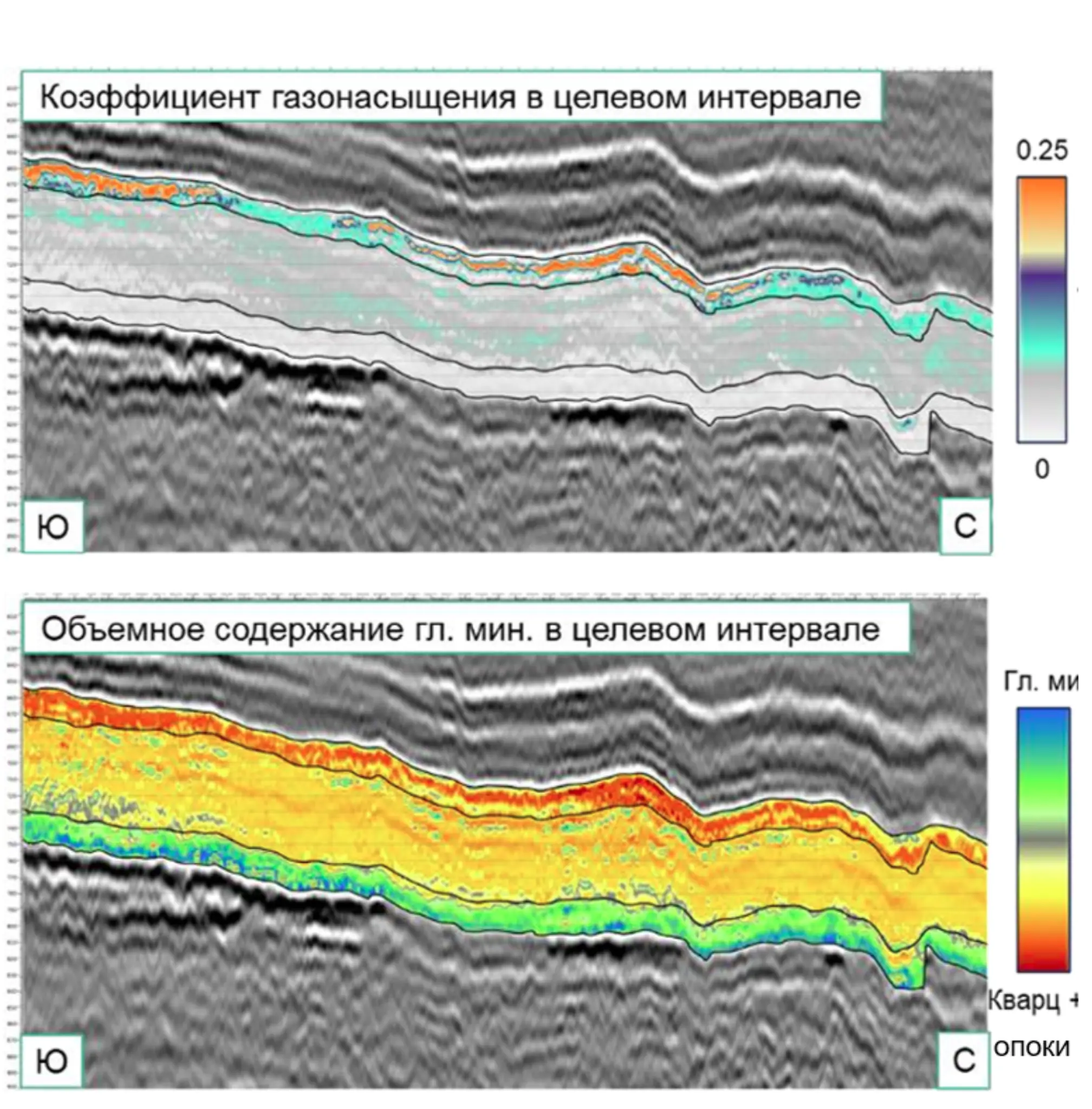
Simultaneous seismic inversion was performed to obtain elastic property cubes, including acoustic impedance and Vp/Vs ratio. Taking into account the complicating effect of gas saturation in the studied interval, the low-frequency elastic property model was built using well data adjusted to water saturation conditions.
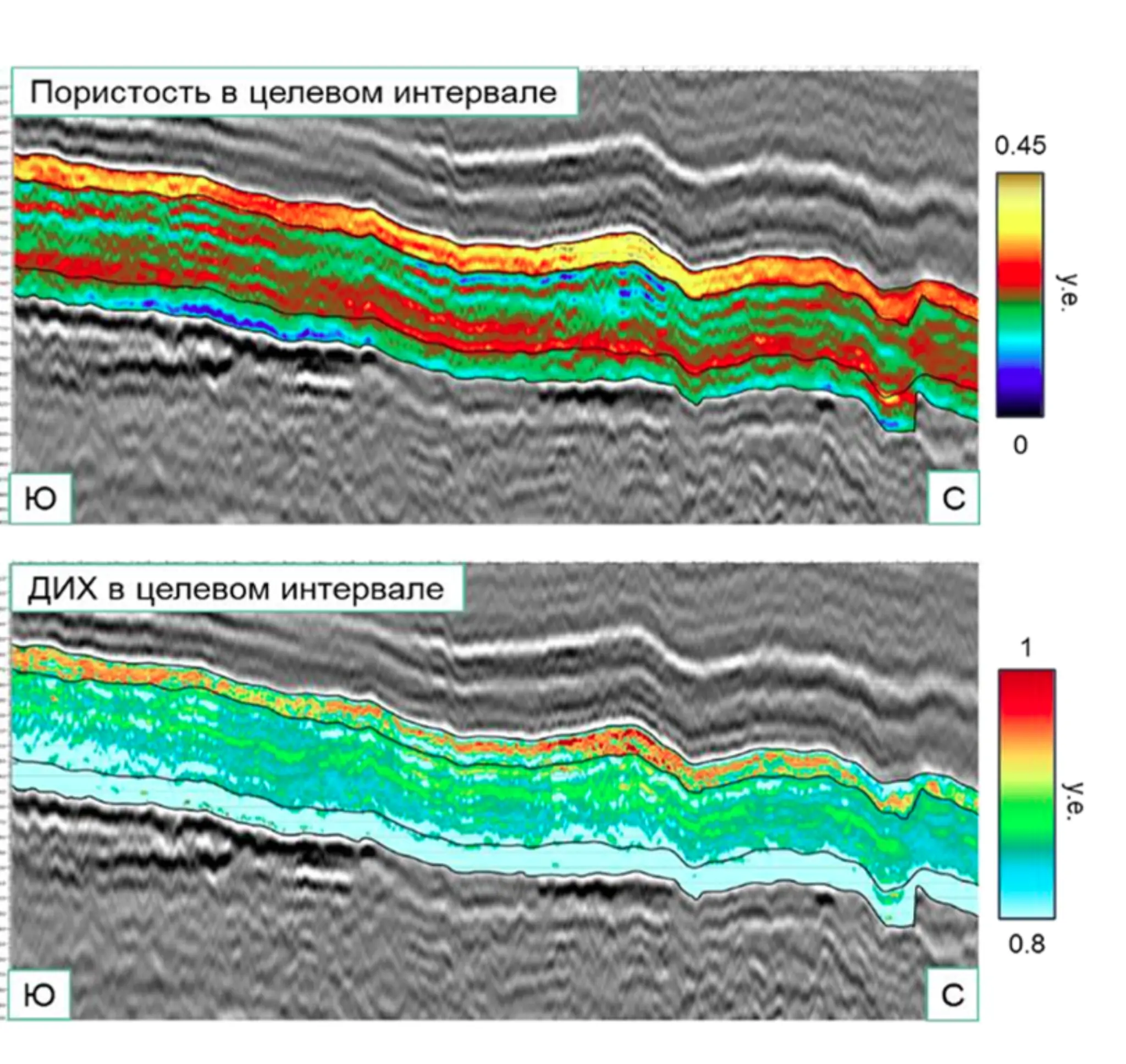
For quantitative prediction of petrophysical properties in the NB₁ interval, rock physics inversion was applied. This technology transforms rock elastic properties into petrophysical properties using a calibrated rock physics model. As a result, gas saturation coefficient, porosity, and shale volume were obtained independently.
Brittleness and ductility are key geomechanical rock properties in the exploration and appraisal of unconventional reservoirs. Brittle rocks have the highest probability of developing a natural microfracture system and are the primary target in unconventional reservoirs for hydraulic fracturing. In this work, brittleness was defined as the ratio of brittle components (quartz and opal) to the sum of all components in the mineralogical model.
Practical takeaway
The proposed approach improves the reliability of petrophysical and geomechanical property prediction for Senonian clay-siliceous rocks. The results provide a basis for selecting optimal zones for hydraulic fracturing.